


The cause of many diseases and poor health is infection with helminths.Various worms can enter the human body.Their sizes vary from the smallest millimeter to 16-18 meters.Parasitizing all organs and tissues, they cause enormous damage to health.To protect yourself from an invasion (infection), it is advisable to know the types of worms and understand how you can become infected by each type of parasite.
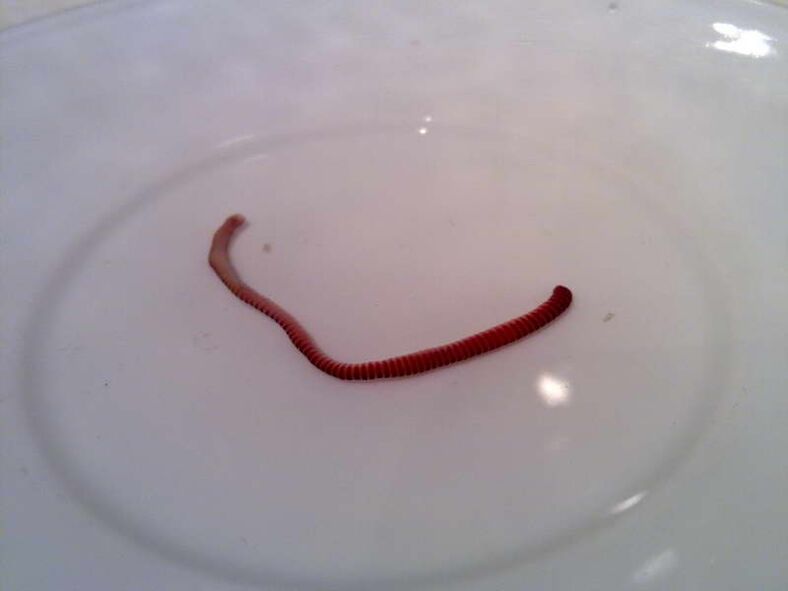
Types of worms - what parasites live in the human body
Depending on the location of parasitism in the body and the characteristics of the infection, parasites are divided into several classes.
Classification of worms according to their location in the human body:
- Intestinalare worms that live in the gastrointestinal tract, primarily in the small intestine.Sometimes they enter other organs.This group includes tapeworms and roundworms.
- Extraintestinal– develop, live and reproduce in various organs outside the intestine.They can be located in the lungs, eyes, brain and liver.This group includes flatworms.
Classification of worms according to the method of entry into the human body:
- Contagious– are transmitted to a healthy person by an infected person during contact.Another source of infection is household items: towels, toys.Representatives of this species are dwarf tapeworms and pinworms.
- Biohelminths– transmitted by contact with an animal, following the consumption of contaminated meat that has not undergone sufficient heat treatment.To become potentially dangerous for humans, these parasites must live a certain period in the body of an animal which is an intermediate host.This species includes bovine and porcine tapeworms.
- Geohelminthiasis– part of the life cycle takes place in the human body and part in the soil.This is a necessary condition for their development.You can become infected from poorly washed fruits and vegetables.This group includes roundworms and trichinae.
Depending on their biological characteristics, helminths are divided into three types: roundworms, tapeworms and flukes.
Roundworms (nematodes)
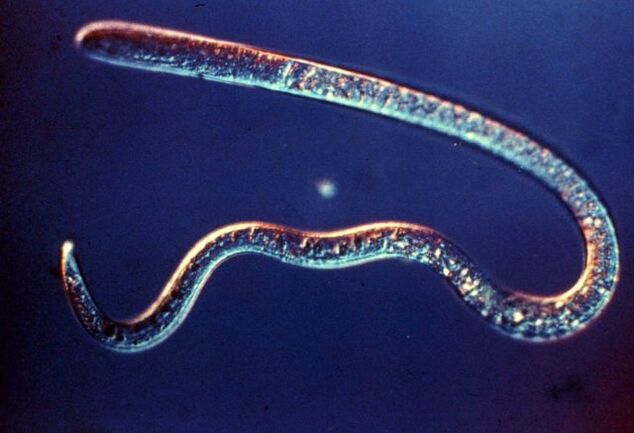
Roundworms are so called because their bodies are round in cross section.These parasites are most often found in a child's body.This type includes:
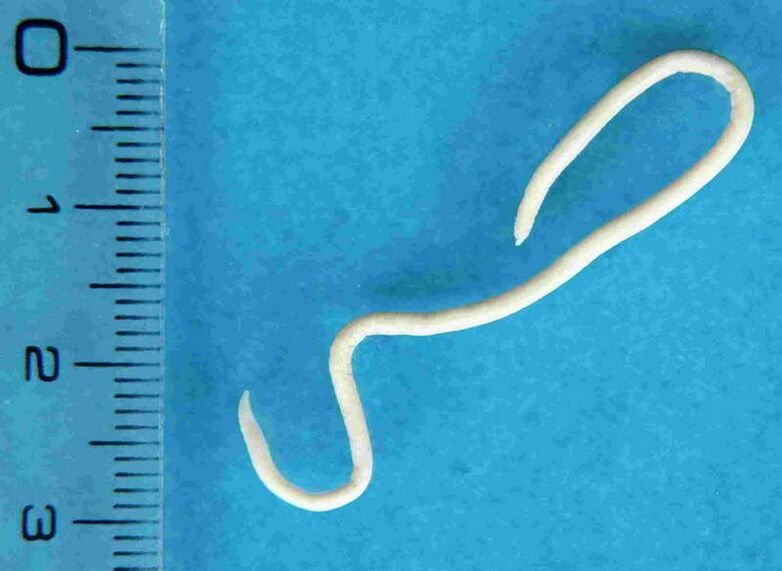
- Pinworms– parasitize the large and small intestines.Their body length does not exceed 1 cm.Most often, helminthic infestations with pinworms affect children.These parasites live 1 to 2 months.If you strictly observe personal hygiene, you can recover even without taking medications.If this is not observed, repeated self-infection is possible.
- Roundworms– worms measuring up to 45 cm long, which parasitize the small intestine.They can move freely through the intestines.Their lifespan is 14 months.During this period, they release toxins into the blood, systematically poisoning the body.
- Whipworm- worms whose body length is 3 to 4 cm.They parasitize the colon and cecum, burrowing through their lining to suck blood.Very toxic.They live up to 5 years.
- Trichinella– a parasite with a length of 3 to 4 mm, which can be infected by meat that has undergone insufficient heat treatment.Helminths live in different organs and settle in the muscles of the eyes, heart and lungs.Life expectancy is up to 2 years.
- Hookworm and necator– have the same biological characteristics, development cycle and method of parasitism, they are therefore grouped under the same name “hookworms”.These helminths, 10 to 15 mm long, are located in the duodenum.They enter the human body through the skin upon contact with contaminated soil.They feed on blood by biting blood vessels, resulting in iron deficiency anemia.This parasite is difficult to identify.
Tapeworms (cestodes)
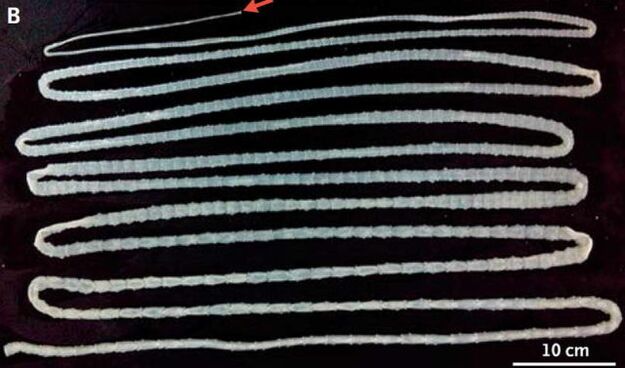
The tapeworm has a flat body divided into segments.As the worm grows, segments separate from the body and are excreted in the stool.These ribbon-shaped individuals can measure up to 20 m long.They parasitize the intestines, where they attach to its walls using suction cups.
To infect a person, tapeworms must go through one of the stages of development in an animal's body.
These parasites live in the body for years.Representatives of this group:
- Large tapeworm– reaches a length of up to 20 m.It parasitizes the small intestine, causing serious dysfunction of the digestive tract.You can become infected by eating meat from freshwater fish and crayfish that has not been heat-treated.
- bull tapeworm- a helminth 6 to 12 m long.Lives in the small intestine, attached by suckers to its mucosa.The source of infection is beef that has not undergone proper heat treatment.
- pork tapeworm– a parasite up to 2 m long, which enters the body through raw or poorly processed pork.Attaches to the walls of the small intestine.
- Echinococcus– a parasite that can be infected by cats and dogs.Humans are an intermediate host for these helminths.Therefore, when entering the body, the larvae penetrate into the tissues, into all organs and form echinococcus cysts.They can only be removed surgically.
- Alveococcus- a type of echinococcus.Very dangerous helminths that can live in any organ, but mainly parasitize the liver.They actively grow and develop according to the principle of cancer metastasis, gradually infecting the entire body.The worms can be surgically removed.
Flukes (trematodes)
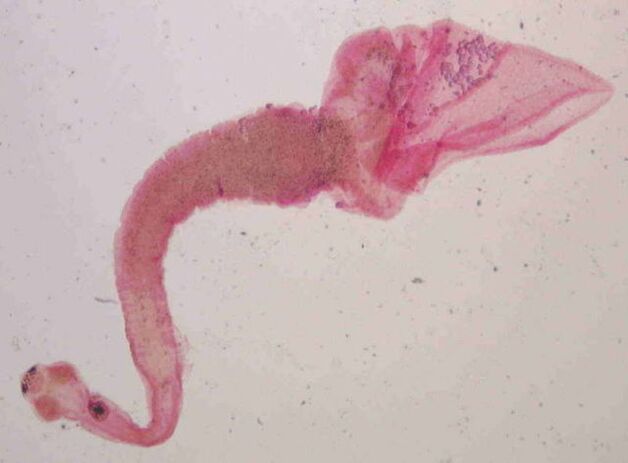
Flukes are a type of worm that parasitizes all organs and tissues.They feed on epithelial cells.They reach a length of 1.5 m.The body is leaf-shaped.The route of infection is the consumption of raw fish and seafood or after insufficient heat treatment.This type includes:
- Liver fluke– a worm 7 to 20 mm long.Parasite the liver and bile ducts.Causes the development of serious diseases and functional disorders.
- Stroke of luck– a worm 4 to 13 mm long, located in the gallbladder.
Symptoms - signs of worms in humans
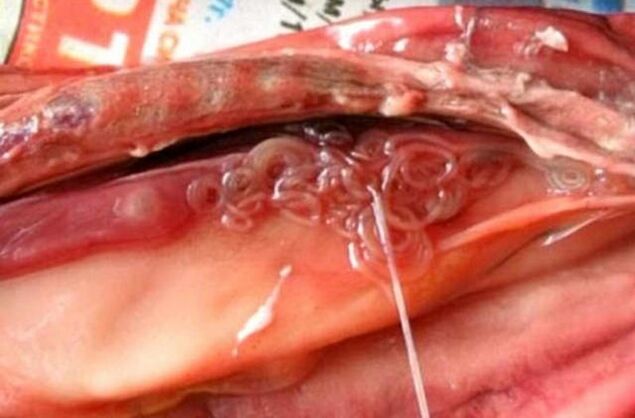
Exactly how helminthiasis manifests itself depends on the type of worms that have infected the body and their number.The main symptoms of a helminthic infestation:
- diarrhea or constipation;
- bloating, flatulence;
- pain in muscles and joints;
- anemia;
- allergic reactions;
- dermatitis;
- weight problems – weight loss or obesity;
- sleep disturbances;
- nervousness, irritability, depressed state;
- apathy, fatigue;
- cough, inflammation of the respiratory tract;
- weakened immunity.

How to determine if there are worms
If symptoms appear that may indicate the presence of worms, it is worth getting diagnosed.The following tests will help identify parasites:
- Stool examination.
- Blood test.
- Study of duodenal secretions.
- Analysis of perianal and rectal mucus.
- Ultrasound, tomography, endoscopy.
You can be sure of the diagnostic result if you take the test 3-4 times with an interval of several days.A single analysis is not enough to confirm the absence of helminthic infestation.
The human body can be affected by one or more types of worms at once.All of them, regardless of their size, cause serious health problems and are the causative agents of complex chronic diseases that cannot be cured for years.To eliminate the risk of infection, it is necessary to periodically carry out diagnostics and preventive treatment.This is especially true for pet owners.